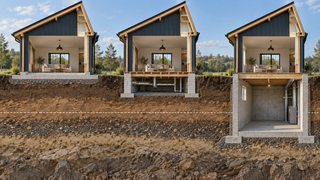
Turning raw land into a buildable site commonly costs $20,000 to $60,000 or more before the first slab is poured, covering clearing, a driveway, a well, a septic system, and getting power to the site. That range is wide because raw land varies enormously, but it is the number almost nobody budgets for when they price a build off the cost of the house alone.
When a builder quotes you a price, that number is tied to the floor plan — it covers the structure itself, not what it takes to get the land ready for it. Clearing, the driveway, the well, the septic system, and power all come due after you already own the land, and together they're the most under-published cost in residential building. Here is what actually goes into that number, item by item, with current sourced ranges for each.
Clearing the land
Land clearing costs $1,200 to $8,000 per acre on average, according to 2025 data from HomeGuide, depending on the property size, terrain, and how dense the vegetation is. Heavily forested land with large trees costs significantly more to clear than land with only small trees and light brush, and price per acre tends to decrease slightly as the total area clears.
A wooded acre and an open acre are not the same line item, and it is worth walking the property with a clearing contractor before you assume a number.
The driveway and any culverts
A gravel driveway runs $4 to $10 per square foot installed, according to HomeGuide, with professional labor typically making up about half the total cost. If the driveway crosses a drainage path, adding a culvert runs an additional $500 to $2,000 depending on the property's drainage needs.
Length matters more on rural land than people expect. A driveway that runs a quarter mile from the road is a meaningfully different budget line than one that runs a hundred feet.
The well
Well drilling costs $30 to $80 or more per foot, or roughly $6,000 to $16,000 on average for a complete 200-foot residential well, according to HomeGuide. That figure includes drilling, casing, the pump, electrical connections, and permits. Depth is the primary driver of cost, and remote sites or rocky, low-quality soil can push the price well past $100 per foot.
Well depth is specific to a piece of land, not a region-wide average. Neighboring properties can have wells at very different depths depending on the local aquifer, so a well log from a nearby parcel is a genuinely useful thing to ask for before you buy.

The septic system
Professional septic system installation costs $3,500 to $12,500 on average, with most homeowners spending around $8,000, according to HomeAdvisor. Labor typically makes up 50 to 70 percent of that total, since installing the tank and field usually costs more than the tank itself. Septic systems are sized by bedroom count, so a larger home on paper can mean a larger, more expensive system on the ground.
Getting power to the site
If the site is not already served by a nearby power line, running electrical service to a new build is a real cost that varies enormously by distance from the nearest utility connection and by whether the utility runs the power line overhead or underground. This is one of the few items on this list without a reliable national average, because utility companies price it individually per job. Call your electric cooperative or utility provider early, since this quote can take weeks to get and can meaningfully affect where on the property you site the house.
What this adds up to
Stacking the ranges above, a raw parcel commonly needs somewhere in the neighborhood of $20,000 to $60,000 of site work before construction on the house itself begins, and difficult sites, meaning steep grades, long driveways, deep wells, or remote power runs, can push considerably past that. Easy sites with short driveways, shallow wells, and good soil can come in under it.
This is also why two people can look at land priced the same per acre and end up with very different total budgets. The land price does not tell you what is under the soil or how far the power line runs.
How to price this before you buy
-
Ask the seller for any existing well logs, septic permits, or soil test results on the property.
-
Call the county health department about septic requirements and percolation testing before you make an offer.
-
Call your electric utility for a rough estimate on running service to the site.
-
Walk the property with a land clearing contractor if it is wooded, and get a real quote rather than a guess.
-
Ask a driveway contractor to look at the distance and grade from the road to your likely home site.
Why this belongs in the design conversation, not just the builder conversation
Where a house sits on a lot affects nearly every number above. Moving a home site fifty feet can shorten a driveway, avoid a difficult well location, or reduce how much clearing is needed. This is a site planning decision, and it is far cheaper to make on paper than to discover after the driveway is already gravel. Book a design consultation before you finalize where the house goes, and we can help you think through site costs alongside the floor plan itself.
Frequently asked questions
How much does it cost to turn raw land into a buildable lot?
Commonly $20,000 to $60,000 or more, covering clearing, a driveway, a well, a septic system, and getting power to the site. Difficult sites with long driveways, deep wells, or remote power runs can cost considerably more.
What is the biggest site prep cost?
It varies by property, but well drilling and septic installation are often the two largest individual line items, together commonly running $10,000 to $28,000 or more depending on well depth and system size.
How much does it cost to clear an acre of land?
Roughly $1,200 to $8,000 per acre, according to 2025 HomeGuide data, depending on terrain and how densely wooded the property is.
Does the cost to run power to a site have a typical range?
Not a reliable national one. Utility companies price line extensions individually based on distance and whether the run is overhead or underground, so this should be quoted directly by your utility provider before you budget it.
Can site costs be reduced by where the house sits on the lot?
Yes. Shortening the driveway, siting the well and septic efficiently, and minimizing the distance to the power connection can meaningfully reduce site costs, which is why home siting is worth deciding alongside the floor plan rather than after.