One of you wants the shop. One wants the gourmet kitchen. The budget covers one of them, and somewhere in the last few weeks this stopped being about the house. A 2025 survey of more than 540 couples who renovated, decorated, or built a home together, conducted by Houzz, found that 59 percent describe the process as collaborative and 50 percent call it fulfilling. It also found that 31 percent name staying on budget as their biggest point of tension, and 20 percent point to agreeing on the design itself. Both things are true at once, and that is normal.
This is not a design problem. It is a decision-making problem that happens to be wearing a floor plan. Here are the four places couples actually get stuck, and a way through each one.
Deadlock 1: One of you wants the shop, one wants the gourmet kitchen
This is the most common version of the disagreement, and it usually is not really about the shop or the gourmet kitchen. It is about which partner's priorities get built first when the budget cannot cover everything on both lists.
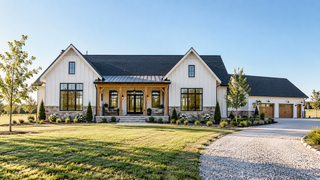
The way through is rarely to pick a side. It is to look for a plan that gives real ground to both without pretending the budget is unlimited. The Maple 2 is a useful example of what that compromise can look like on paper: an open kitchen and living space at the center of the plan, a dedicated office to the side, and a breezeway leading to an attached 3-car garage and shop. Neither priority got the leftover space. Both design features were included in the plan.

If a full compromise plan is not available or not affordable, the more honest question is which priority is expensive to add later and which is not. A shop can often be phased in as a future outbuilding. A gourmet kitchen almost never gets a second chance once the house is framed. That is not an argument for one partner winning. It is information both partners need before they decide.
Deadlock 2: You cannot agree on the budget, only on the wish list
The Houzz survey found budget disagreement is the single most common point of tension for couples building or renovating together, named by 31 percent of respondents, ahead of design, scope, or product selection. That tracks with what we see in early design meetings: two people arrive with two wish lists and no shared number to measure either one against.
The fix is procedural, not emotional. Set the total budget before either person's wish list gets drawn into a plan. Then price the wish lists against that number together, in the same conversation, rather than negotiating item by item after the fact. Couples who set the ceiling first argue about trade-offs. Couples who skip that step argue about each other.
Deadlock 3: You do not agree on the design, and neither of you can quite say why
Twenty percent of couples in the Houzz survey named agreeing on the design itself as a top source of tension, tied with agreeing on project scope. Forty-four percent said using visualization tools helped them find common ground.
This is the deadlock that is hardest to argue through in words, because two people can look at the same floor plan and picture two different rooms. A 3D walkthrough removes the guessing. When both partners can see the same space from the same angle, most design disagreements turn out to be a misunderstanding rather than a real conflict of taste.
Fry Design Co builds a photorealistic 3D walkthrough for our plans for exactly this reason. It is far easier to agree, or to identify what you actually disagree about, when you are both standing in the same room instead of describing two different ones.
Deadlock 4: One of you keeps giving in, and starting to resent it
The Houzz data shows an interesting pattern here. More than half of couples overall, 56 percent, report compromising to get through renovation or building challenges. But that compromise is not distributed evenly. Couples earlier in their relationship are the most likely to compromise, at 64 percent, while longer-term couples are more likely to have one partner simply defer to the other, 10 percent versus 5 percent for newer relationships.
If you notice the same person deferring on every decision, that pattern is worth naming out loud before the house is finished, not after. A designer's job includes asking each partner separately what they actually want, on purpose, because the answer in a shared meeting is not always the same answer you get one at a time.
Why a third party in the room helps
This is one of the quieter reasons people hire a designer instead of designing a house themselves. A good designer is not on either partner's side. The job is to hear both lists, name the real trade-offs in dollars and square footage, and keep the conversation about the house rather than about who wins.
The 2025 Houzz survey also found that when couples work with design and construction professionals, what they want most is transparent pricing (45 percent), clear communication (42 percent), and accurate timelines (39 percent), which is a fairly direct description of what a good design process is supposed to provide in the first place.

The part worth remembering
The same survey found that despite the friction, 96 percent of couples said the finished result made the process worthwhile. The disagreements are real, and they are also temporary. The house outlasts the argument about the house.
If you and your partner are stuck between two different versions of the same house, that is a conversation worth having with a designer before it becomes a conversation you keep having with each other. Book a design consultation and bring both wish lists.
Frequently asked questions
Is it normal for couples to disagree when building a house?
Yes. A 2025 survey of more than 540 couples by Houzz found budget, design, and scope disagreements are common, with 31 percent citing budget as their top source of tension. The same survey found 96 percent of couples said the finished result was worthwhile despite the friction.
How do couples usually resolve disagreements about a floor plan?
According to the Houzz survey, 56 percent of couples report compromising to work through challenges, and 44 percent used visualization tools such as 3D renderings to help reach agreement.
What is the most common thing couples argue about when building a house?
Staying on budget, cited by 31 percent of couples in the 2025 Houzz survey, followed by selecting products or finishes at 28 percent, and agreeing on project scope or design, both at 20 percent.
Should we set a budget before or after we make our wish lists?
Before. Setting the total budget first gives both partners a shared number to measure trade-offs against, rather than negotiating each item after wish lists are already drawn into the plan.
Can a designer help two partners with different priorities agree?
Yes. A designer who is not on either side can translate both people's priorities into real trade-offs in dollars and square footage, which keeps the conversation focused on the house rather than on who is winning the disagreement.