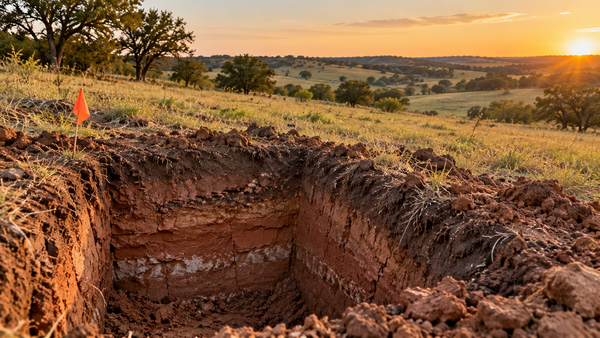
There is a rural water line at the road, and a neighbor down the way who swears by his well and would never switch. Both of them might be right for their own situations, and the honest answer for a new build depends on upfront cost, ongoing cost, and how much control you want over your own water supply. Here is how to actually work through it.
Upfront cost: well
Well drilling costs $30 to $80 or more per foot, or roughly $6,000 to $16,000 on average for a complete 200-foot residential well, according to HomeGuide. That figure covers drilling, casing, the pump, electrical connections, and permits. Depth is the primary cost driver, and it is specific to your parcel's aquifer, not a regional average, so a neighboring property's well depth is a useful reference point but not a guarantee.
Upfront cost: rural water
Connecting to a rural water district requires a tap fee plus the cost of running a line from the main to your home site, and both numbers vary enormously by provider and distance. Tap fees alone can range from several hundred to tens of thousands of dollars depending on the water line size and the utility's own fee schedule. A full public water connection, including trenching and tap fees, commonly runs $1,500 to $15,000 or more, according to a 2026 utility cost analysis, with distance from the existing main and any road crossings being the biggest factors that push a specific quote toward the higher end.
The only way to get a real number is to call the rural water district directly and ask for their current tap fee schedule and an estimate for your specific distance from the main. Providers publish these rates individually, and they are not standardized across counties, let alone states.
Ongoing cost and control
A well has no monthly water bill, but it is not free to operate. Running the pump costs electricity, and the system needs periodic maintenance, water testing, and eventually pump or component replacement over the life of the well. In exchange, you have full control over your own supply, no dependency on a utility's rates, and no risk of a rate increase decided by a rural water board.
A rural water connection carries a predictable monthly bill in exchange for someone else handling water quality testing, treatment, and system maintenance. You give up control over rates and are dependent on the utility staying operational, but you also give up the maintenance burden and the risk of a well running dry or a pump failing with no backup source.
Reliability: what happens when each one fails
When a well fails, whether from a dry aquifer, a failed pump, or contamination, the household loses water entirely until it is fixed, and the homeowner is fully responsible for diagnosing and paying for the repair. When a rural water system fails, whether from a water main break, a treatment plant issue, or a boil order, water may be interrupted for the entire district at once, and while the utility bears the cost of repair, the homeowner has no ability to expedite their own restoration.
Neither failure mode is clearly better. A well failure is a homeowner's problem to fix but only affects one household. A rural water failure is someone else's problem to fix but affects everyone on the system at once and is entirely outside the homeowner's control.
The acreage threshold where a well usually wins
On smaller lots close to existing infrastructure, rural water access is often close enough that the connection cost is modest and the convenience wins easily. As distance from the main increases, the trenching cost of a rural water connection climbs steadily, while a well's cost is driven by depth rather than distance from a road. On larger rural parcels, particularly those more than roughly a quarter mile from the nearest water main, a well frequently becomes the more cost-effective choice simply because the connection distance for rural water gets expensive fast, while drilling a well does not care how far you are from the road.

What to check before you decide
-
Call the rural water district and get a written tap fee and connection cost estimate specific to your parcel, not a general rate sheet
-
Ask neighbors with wells on similar land what their depth and any water quality issues have been
-
Have any well water tested for quality before relying on it, since water quality varies significantly by location and aquifer
-
Confirm whether your property is even within a rural water district's service area, since not all rural parcels have that option regardless of preference
If you are planning a home on acreage and have not yet decided between a well and rural water, that decision affects where the house sits on the lot as much as it affects the budget. Book a design consultation and we can help you think through both together.
Frequently asked questions
Is well water cheaper than rural water in the long run?
It depends on your distance from the water main. Wells are priced by depth, not distance, so on larger or more remote parcels a well is often more cost-effective than a rural water connection that requires a long trenching run.
How much does it cost to drill a well?
Roughly $30 to $80 or more per foot, or $6,000 to $16,000 for a typical 200-foot residential well, according to HomeGuide. Depth varies significantly by parcel and aquifer.
How much is a rural water tap fee?
Tap fees vary widely, from several hundred to tens of thousands of dollars, and a full connection including trenching commonly runs $1,500 to $15,000 or more. Contact the specific rural water district for a written estimate for your property.
What happens if a well runs dry?
The homeowner is responsible for diagnosing and fixing the issue, which may mean drilling deeper, drilling a new well, or in rare cases finding the aquifer inadequate for the property. This is a real risk worth discussing with neighbors and a local well contractor before committing to a well.
Can every rural property connect to a water district?
No. Not all rural parcels fall within a rural water district's service area. Confirm service availability with the district directly before assuming rural water is an option for a specific piece of land.